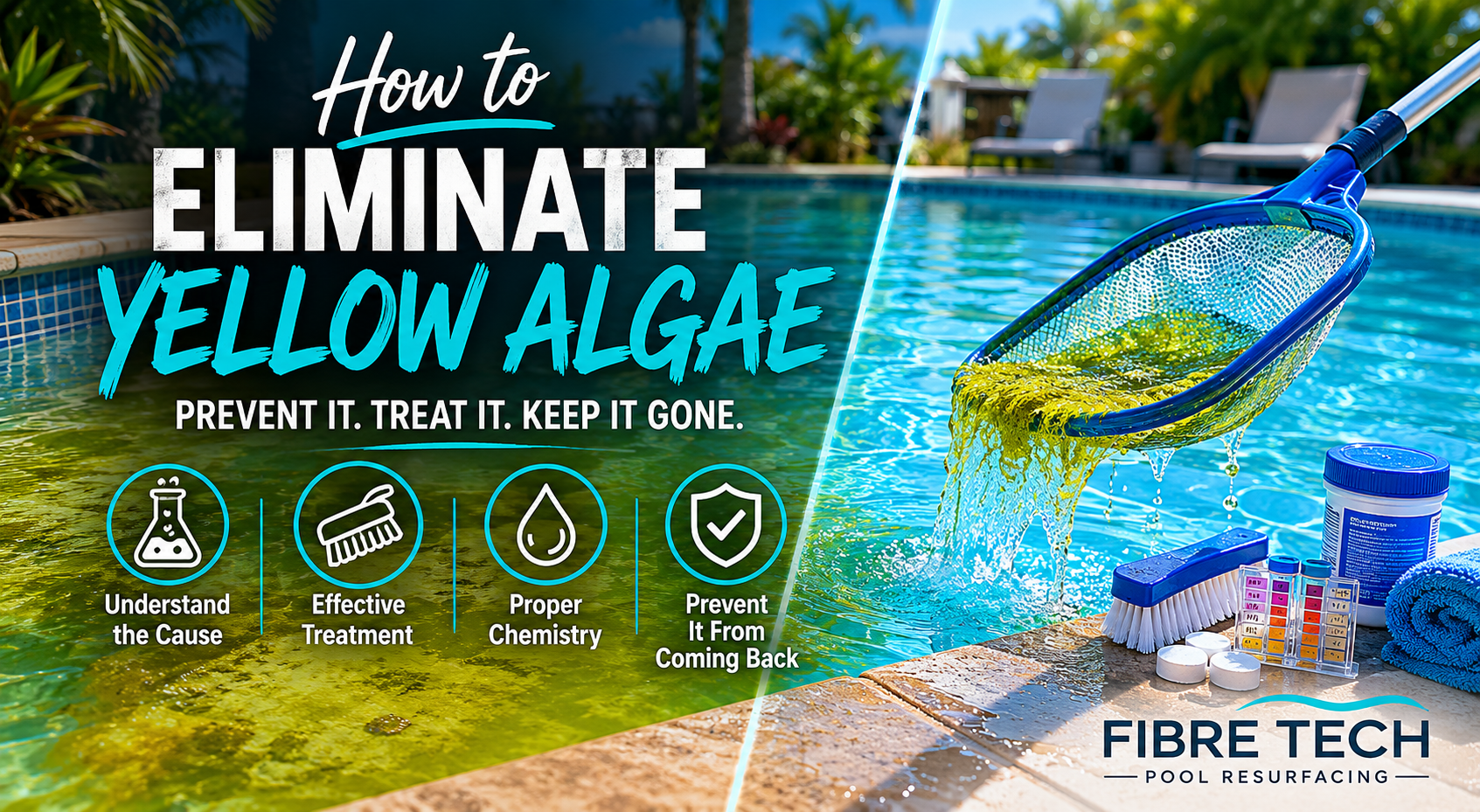
Yellow algae, also called mustard algae, is one of the most stubborn problems Florida pool owners deal with going into summer. It usually shows up as a yellow or brown dusty film along pool walls, steps, shady corners, behind ladders, and dead circulation zones.
A lot of homeowners think it's pollen. Sometimes it is. Most of the time it's algae starting to bloom.
In Tampa Bay's heat, humidity, and heavy rain cycle, yellow algae spreads fast once chlorine falls behind.
The good news: you do NOT need magic chemicals or fifty pool store products.
At Fibre Tech, we keep it simple.
The Method We Use
SLAM + Polyquat
That's it.
Done correctly, this combination absolutely nukes yellow algae.
What Is Yellow Algae?
Yellow algae is chlorine-resistant algae that clings to pool surfaces and hides in low-flow areas.
Unlike green algae floating in water, mustard algae behaves more like a surface contaminant.
Common locations:
- Pool walls
- Steps
- Light niches
- Under ladders
- Skimmers
- Return dead spots
- Vacuum hoses
- Automatic cleaners
It often comes back because homeowners kill what they see, but not what's hiding in the system.
Why Florida Pools Get It So Often
Florida is basically perfect algae weather:
- Warm water
- Constant UV exposure
- Frequent rain dilution
- Heavy organic load
- High swimmer usage
- Long pool seasons
And older rough pool surfaces make it even worse.
As surfaces age, pores open up, texture roughens, contaminants cling easier, and brushing becomes less effective. That's one reason older marcite and deteriorated surfaces become harder to maintain over time.
What Does SLAM Mean?
SLAM stands for Shock Level And Maintain.
The key word is MAINTAIN.
Most homeowners shock the pool once and quit. That's not a SLAM.
A real SLAM means:
- Bringing chlorine to shock level
- Holding it there
- Brushing constantly
- Filtering continuously
- Continuing until algae is fully dead
That consistency is what actually wins.
The SLAM process was popularized by Trouble Free Pool and is widely considered one of the most effective ways to eliminate stubborn algae problems.
Step 1: Balance pH First
Before starting, lower pH to roughly 7.2.
High chlorine temporarily interferes with pH readings, so adjust this before starting.
Step 2: Clean the Pool Physically
This matters more than people think.
Remove leaves, debris, dirt, and organic material. Then brush walls, steps, corners, tile line, and shady areas.
Yellow algae protects itself with biofilm. Brushing breaks that protective layer apart so chlorine can kill it.
Step 3: Run the Pump 24/7
During SLAM, your filtration system needs to run continuously.
Also:
- Clean cartridges
- Backwash sand filters
- Monitor pressure rise
Dead algae has to leave the water somehow. Poor circulation is one of the biggest reasons algae returns.
Step 4: Raise Chlorine to Shock Level
This is where most people fail.
You need enough chlorine for long enough.
Liquid chlorine works best because it's fast acting, predictable, adds no unwanted stabilizer buildup, and adds no calcium.
Shock level depends on your CYA level. Too much stabilizer (CYA) weakens chlorine effectiveness significantly.
Step 5: MAINTAIN Shock Level
This is the entire game.
Test frequently. Add chlorine frequently.
Early in the process, algae burns chlorine aggressively — which means you cannot dump chlorine in once and walk away.
A true SLAM often requires:
- Multiple tests daily
- Repeated chlorine additions
- Aggressive brushing
- Patience
This may take one day, several days, or occasionally longer on severe pools.
Step 6: Add Polyquat 60
This is where we separate yellow algae from ordinary algae treatment.
We like using Polyquat 60.
Why? Because mustard algae can survive in areas chlorine struggles to fully penetrate.
Polyquat helps:
- Disrupt resistant algae
- Improve kill effectiveness
- Reduce rebound risk
- Avoid metal staining issues associated with copper-based algaecides
Pool professionals often use Polyquat 60 specifically against mustard algae because of its broad-spectrum effectiveness.
Important: Do NOT use cheap copper algaecides unless you enjoy staining headaches later.
Step 7: Brush EVERYTHING Again
This is the step people skip.
Brush walls, floor, ladders, toys, poles, vacuum heads, and skimmer throats.
Yellow algae hides everywhere. If you kill 95% of it, the other 5% comes right back.
Step 8: Clean the Filter Again
Dead algae loads filters heavily.
After treatment:
- Clean cartridges thoroughly
- Backwash sand filters
- Recharge DE if applicable
If the filter is filthy, you can literally reintroduce contamination back into the pool.
How Do You Know It's Gone?
You're finished when:
- Water is crystal clear
- No visible algae remains
- Chlorine demand stabilizes
- Overnight chlorine loss is minimal
A successful SLAM leaves the water completely clear with no visible algae growth.
Why Yellow Algae Keeps Returning
Usually one of these:
- Low chlorine
- Poor circulation
- Dirty filter
- High phosphates
- High CYA
- Rough aging surface
- Dead zones
- Inconsistent maintenance
Or honestly — the pool was never fully cleared the first time.
Florida Pool Owner Reality Check
If your pool constantly eats chlorine, develops algae quickly, feels impossible to maintain, stains easily, has rough porous surfaces, or keeps growing algae in the same spots — it may not only be chemistry.
Older deteriorated pool surfaces can become extremely difficult to keep clean because contaminants physically embed into the finish itself. That's especially common with aging marcite, delaminating plaster, or worn fiberglass finishes.
Final Thoughts
Yellow algae is beatable.
But random shock treatments usually fail because they don't maintain chlorine long enough or attack the root problem correctly.
Our recommendation:
- Proper SLAM process
- Aggressive brushing
- Continuous filtration
- Polyquat 60
- Patience
Done correctly, that combination is brutally effective.
And if your surface has reached the point where maintenance is becoming a constant battle, it may be time to evaluate whether the finish itself is contributing to the problem.